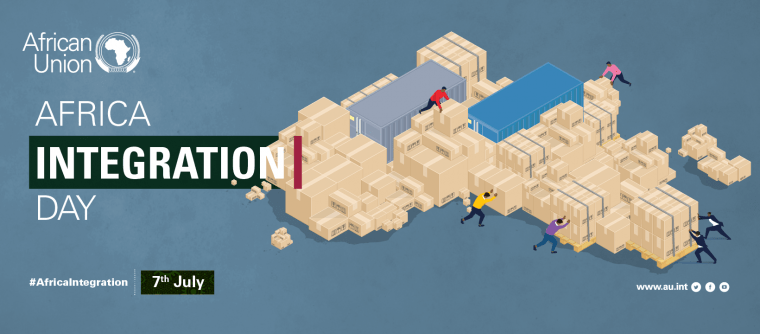
The African Union led by the Department of Economic Development, Trade and Mining, will commemorate the African Integration Day 2021 under the theme “The Role of Continental Integration in Accelerating African Economic Recovery from the COVID-19 Pandemic.”
In 2019, the African Union Heads of State and Government designated 7th of July of each year as “the African Integration Day” to celebrate major achievements attained in regional and continental integration process, and also, to deliberate on critical lessons learned, with a view of addressing challenges faced.
Africa’s integration Agenda is enshrined in the Abuja Treaty (1991), and has an overarching goal of achieving an African Economic Community at continental level, in six successive stages, which include the strengthening of sectoral cooperation and the creation of regional free trade areas, establishment of a continental Customs Union, a Common Market and a monetary and economic union. It is understood that consolidation of the Common Market will hinge free movement of people, right of residence and right of establishment.
A historic milestone for regional integration in Africa was recorded on 1 January 2021 with the start of trading under the African Continental Free Trade Area (AfCFTA). The remarkable speed of negotiations, signature, ratifications and entry into force of the AfCFTA Agreement took place between June 2015 and May 2019 and is unprecedented in the treaty making history of the AU just behind the Constitutive Act of the Union. Despite the adoption and implementation of the AfCFTA, the results in attaining the objectives of the Abuja Treaty remain rather mixed with the RECs at different stages of implementation of the Treaty. In addition, more effort is needed to make the ordinary African Citizens understand and own the regional integration process.
In 2013, member states of the African Union agreed upon “Agenda 2063: The Africa We Want”, working towards an integrated, prosperous and peaceful Africa, driven by its citizens, representing a dynamic force in the international arena.
Over the last two decades, Africa has recorded a 4.6 % growth rate on average, despite an unfavourable international economic and financial environment. The current COVID-19 pandemic plunged the continent into its first recession in 25 years. Faced with the disruption of global and regional supply chains due to government containment, restriction measures put in place to combat COVID 19 and the structural weaknesses inherent in African economies characterised by underdeveloped, fragmented small markets, the ongoing COVID-19 pandemic has once again exposed and exacerbated the vulnerability of African economies.
In the perspective of reaching Agenda 2063 annual growth target of 7%, there is a growing consensus among the African Union Member States about the role regional integration can play in fostering inclusive growth and structural transformation.
The 2nd commemoration of the African Integration Day will take place from 7 to 9 July 2021. During this commemoration, the AUC will also organise the African Integration Forum as recommended by the meeting of the Specialized Technical Committee (STC) on Finance, Monetary Affairs, Economic Planning and Integration at its meeting held in Yaoundé (Cameroon) from 5 – 8 March 2019, which requested the African Union Commission (AUC) to organize, annually, a Forum on African Integration.
These commemorations will provide a platform that ensure broad participation of all actors at the national, regional and continental levels, including Member States, RECs, the African Diaspora, Development Partners, Academia, Private Sector, Civil Society, Women and Youth to keep alive the dream of a unified, prosperous and peaceful Africa as enshrined in the Abuja Treaty and Agenda 2063.
The commemorations will include a number of activities, covering among others:
- Status of regional integration in Africa;
- Dissemination of the 2021 African Integration Report;
- Discussions on African Integration Programmes;
- Market Integration: practical modalities and successful implementation of the AfCFTA;
- Challenges encountered in the implementation of regional and continental integration agenda;
- Issuance of joint statements by the Chairperson of the Union, Chairperson of the AU Commission and the Champion of the AfCFTA;
- Launch and follow up of programmes and initiatives on regional integration; and
- Free movement of persons, right of residence and right of establishment.
Expected Outcomes
The following outcomes are expected:
- Promoting civic participation for an inclusive implementation of Africa’s regional integration agenda. This is essential to foster the popularization of the idea of regional integration and promoting broad citizen ownership and participation;
- Foster co-ordinated policy-making processes through inclusive dialogue for the identification of appropriate, practical and effective means to accelerate continental integration, including addressing, issues around sovereign, which have found to impede accelerated integration process;
- Improved assessment for better policy formulation through the production of a Meeting Report and a Progress Report on the implementation of initiatives launched during the 2020 commemorations of the Africa Integration Day;
- Enhanced understanding and awareness by Africans on the Continent and in the Diaspora on integration matters, and AfCFTA in particular, and the current status of its implementation;
- Strengthened political will and leadership for Africa’s integration through advocacy efforts targeted at AU Member States to accelerate the ratification, domestication and implementation of AU legal instruments related to continental integration, especially the Protocol to the African Economic Community on Free Movement of Persons, Right of Residence and Right of Establishment;
- Generation of momentum to expedite conclusion of outstanding treaties and protocols, including those related to the establishment of 3 proposed African Union financial institutions (namely, the African Central Bank, African Investment Bank, and African Monetary Fund) among others; and
Strengthened cooperation between African Union Institutions, RECs and Member States on regional integration.
Source: Africa Union